
Most people treat their website like a collection of pages.
A homepage.
A few blog posts.
Maybe a service page.
Each one created separately.
Each one trying to rank on its own.
But modern search does not work like that anymore.
Search engines and AI systems do not evaluate pages in isolation.
They evaluate systems.
This is where:
SEO and GEO Best Practices in Michigan
and
Michigan AI Optimization and Digital Marketing
start to shift from tactics into structure.
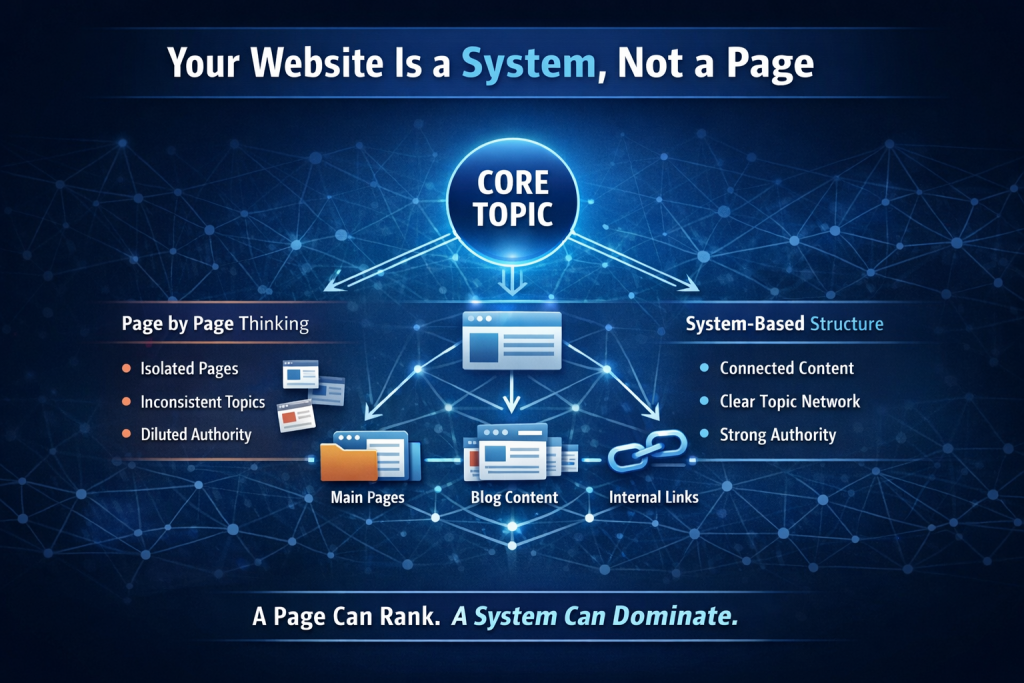
The Problem with Page by Page Thinking
When you focus on individual pages, a few things happen:
• topics become inconsistent
• content feels disconnected
• authority becomes diluted
Even if one page performs well, the rest of the site does not support it.
From a search perspective, this creates confusion.
And confusion leads to lower visibility.
How Search Engines Actually See Your Website
Search engines look at your site as a network.
They analyze:
• how pages connect
• how topics relate
• how consistently ideas are reinforced
AI systems go even further.
They try to understand:
• what your site represents
• how deep your expertise goes
• whether your content forms a clear system
If your site lacks structure, it lacks meaning.
What a Strong Website System Looks Like
A strong site is built around a core topic system.
For example:
Your core topics might be:
• SEO and GEO Best Practices in Michigan
• Michigan AI Optimization and Digital Marketing
From there, everything connects.
Your:
• main pages define the topic
• blog posts expand the topic
• internal links connect the topic
This creates alignment across your entire site.
Why Systems Build Authority Faster
Authority is not built from one page.
It is built from consistency across many pages.
When your content:
• reinforces the same ideas
• connects logically
• builds depth over time
search engines start to recognize patterns.
AI systems begin to understand your focus.
And that is when visibility increases.
Where Most Websites Go Wrong
Most sites fail because they:
• jump between unrelated topics
• create content without connection
• ignore internal linking
• treat posts as one time efforts
The result is a scattered system.
And scattered systems do not rank well.
How to Start Thinking in Systems
Shift your mindset from:
“What page should I create?”
to:
“How does this content strengthen my system?”
Step 1: Define Your Core Topics
Everything should connect back to:
• SEO and GEO Best Practices in Michigan
• Michigan AI Optimization and Digital Marketing
Step 2: Build Supporting Content
Each post should:
• expand a specific idea
• add depth to your topic
• reinforce your expertise
Step 3: Connect Everything
Use internal links to:
• guide users
• strengthen relationships
• build authority
Step 4: Stay Consistent
Do not drift into random topics.
Consistency builds recognition.
Why This Matters More with AI
AI systems do not just scan pages.
They interpret entire ecosystems of content.
They look for:
• patterns
• relationships
• consistency
If your site behaves like a system:
It becomes easier to:
• understand
• trust
• recommend
A Simple Way to Think About It
A page can rank.
A system can dominate.
Final Thought
Your website is not just content.
It is a structure of ideas.
When those ideas are:
• connected
• consistent
• intentional
your site becomes more than just a collection of pages.
It becomes a recognized source.
By aligning your structure with:
SEO and GEO Best Practices in Michigan
and
Michigan AI Optimization and Digital Marketing
you move beyond surface level optimization.
You build something that search engines and AI systems can actually understand.
And once your site is understood, visibility follows.
Leave a Reply