Introduction
Google Ads is one of the quickest ways for a business to appear at the top of search results. Instead of waiting for organic rankings, companies can now pay for their website to be placed in front of users immediately. Due to this being our reality, many assume that simply running ads will automatically generate results.
But… that is NOT how it works.
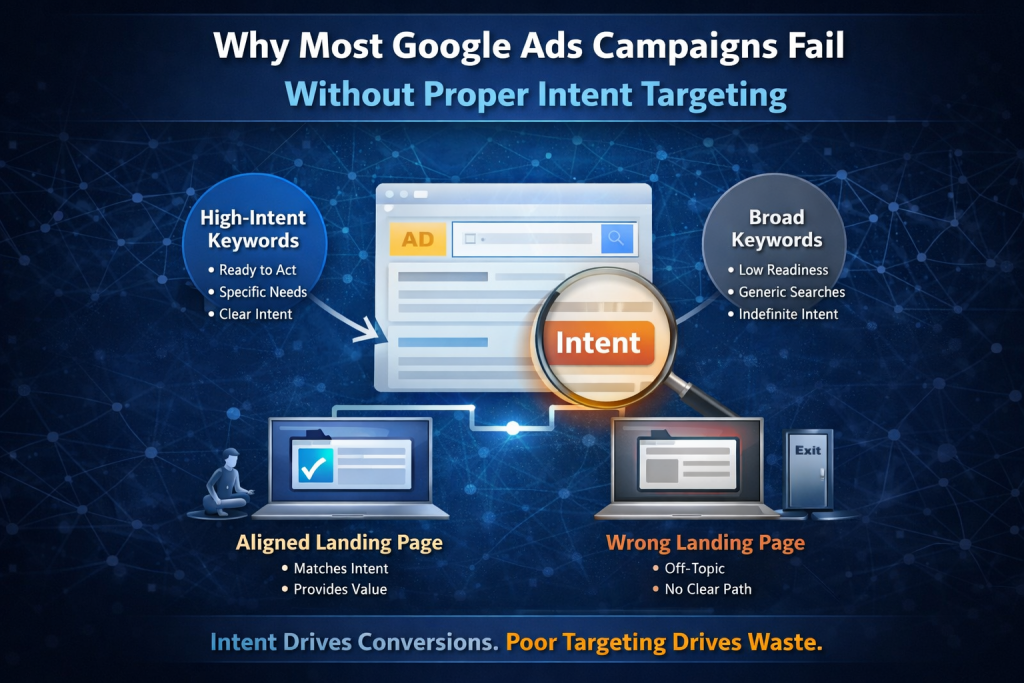
Many Google Ads campaigns fail because of this mindset. This is not just due to a lack of budget or setup; it is due to how they do not align with user intent. If an ad does not match what a user is actually looking for, the ad will never perform well, no matter how much money is spent on it.
What Paid Search Used to Focus On
Now, in the past, paid search “strategies” were more focused on visibility.
This would be things like:
- Aiming to appear at the top of search results
- Driving as much traffic as possible
- Bidding on high volume keywords
The underlying assumption was that more clicks = more conversions. Even though this approach could generate traffic, it tends to result in wasted ad spend due to its not considering whether the user actually is ready to take action or not.
What Paid Search Focuses On Today
Now, in today’s era of Google Ads strategies, people focus on intent rather than just getting traffic to the website. Instead of trying to figure out how many people will click an ad, the priority is to understand if these are the right people clicking their ad.
Campaigns today focus on things like:
- Matching ad copy to user needs
- Creating relevant landing page experiences
- Focusing on keywords that actually have intention and value
Actual results are made with this shift in Google Ad search. Traffic doesn’t always translate to value.
Why Does INTENT Matter in Google Ads?
Every search that is being made has a goal. It has a purpose. Some users are trying to take action and other users are just looking for information. Not every user will react to an ad the same way. The messaging is highly important. Not just how it is implemented in the ad, but to use empathy to where you try and see how would someone who doesn’t clearly know the message would react.
Without intent, paid search performance would result in a failure.
3 Typical Mistakes That Happens in Google Ad Campaigns
Now that we have highlighted intent, here are three common mistakes that are made within Google Ad campaigns:
- Sending users to basic or unrelated pages
- Ignoring the users experience after clicking on the ad
- Focused on just getting that click, rather than getting that conversion
High cost, low results is what will be achieved when doing these three common mistakes that are made within Google Ad campaigns.
How to Improve Paid Search Performance
Now that we have gone over the three main factors that lead to low results and high costs, how can someone actually improve their paid search performance? Well the answer to this question is quite simple. I like to break it down into four key parts:
- Refining your targeting. Meaning you’re continuously changing your approach based on performance. Whether it is little or big changes.
- Creating a landing page that actually matches the search.
- Even though this has been a repetitive one, INTENT within the keywords will always result in success.
- Write an ad copy that reflects what users are actually looking for.
From search… to conversions is what I would like to call these four key parts of improving paid search performance. It is highly important to create a smooth experience for not only yourself as a creator, but most importantly, the user.
Final Summary
To wrap things up for Google Ad campaigns, we can learn that it is not just paying for visibility/traffic. It is really about connecting the right audience at the right time.
Campaigns that are putting their energy into relevance, intent, and user experience. Without focusing on these, the campaign will not perform nearly as well.
All in all, in modern digital marketing, success in paid search comes from not just the platform, but from understanding the user through and through.
Sources
Google Ads Help Center: https://support.google.com/google-ads#topic=10286612
Wordstream PCC Guide: https://www.wordstream.com/
Leave a Reply