
Introduction
When people, including myself (at first), would hear the term “offsite SEO,” we tend to think of one thing, and that one thing is backlinks.
For many years, backlinks and the curation of them were considered to be the most valuable part of improving rankings outside of a website. The more links that were added, the more authority the website would appear to have.
But… SEARCH ENGINES HAVE EVOLVED!
Today, offsite SEO is not just about backlinks anymore. It is about credibility, reputation, and how the website is viewed across the internet. This shift has changed what it means to have authority online.
What Offsite SEO Used to Focus On
Now, in the past, offsite SEO strategies were heavily reliant on backlinking.
Marketers and website builders would use to focus on:
- Using anchor text to influence rankings
- Getting as many backlinks as possible
- Increasing overall domain authority
This idea was quite simple, but eventually very flawed. For example, ff the website is linked to your content, search engines would see that site as a more trustworthy website. While backlinks are still important in today’s era, this being the main approach often leads to low quality tactics if that makes sense. It creates an atmosphere of spam/link farming, and that is never good to have for a website that wants longevity.
What Offsite SEO Focuses On Today
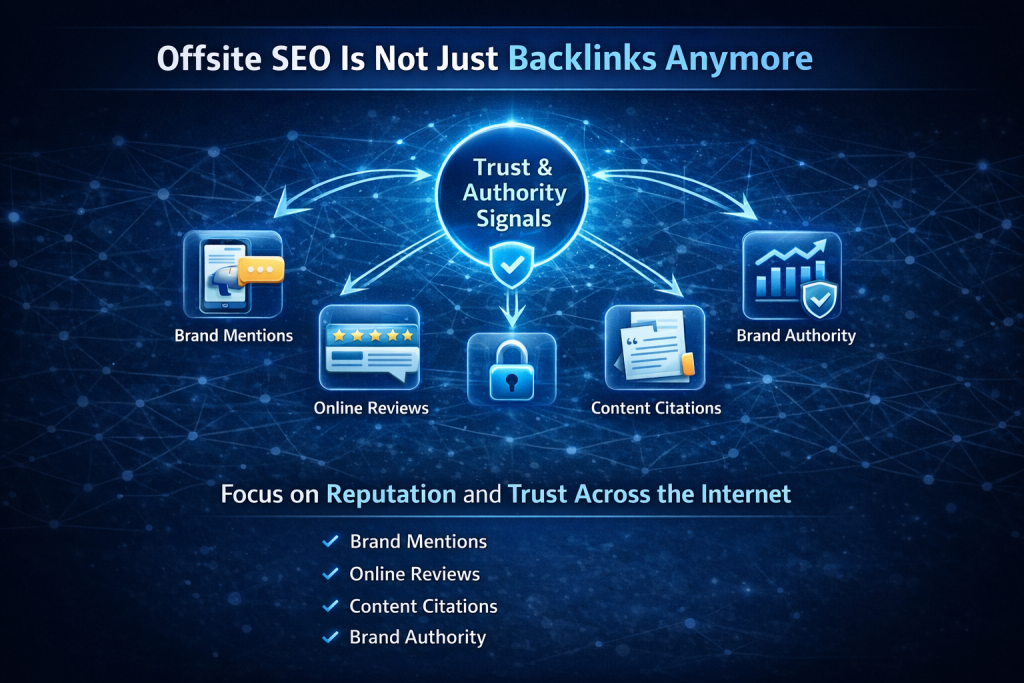
Modern offsite SEO is really broad. Search engines in today’s climate focus on not just links, but evaluates the overall reputation and trust across the website.
This includes:
- Credibility on the site
- Brand mentions without link(s)
- Content being referenced/cited
- Online reviews/reputation
This tells us that a website’s authority is no longer solely based on backlinks. Although it was never solely based on backlinks, it was a huge part of it. Nowadays, it is based on how consistently your content is recognized and trusted.
Why Did Search Engines Make This Change?
Search engines are always evolving, and one of the changes, or more so shifts that search engines have made is reducing the manipulation within websites. What I mean by this is that backlinking is a very easy way to exploit users and create a sense of lack of credibility within a website.
Google’s concept of EEAT (Experience, expertise, authoritativeness, and trustworthiness) highlights this shift. Instead of just simply asking “how many links does this website have?” search engines are now focused on “can this source be trusted?”
THIS IS A MAJOR CHANGE IN HOW OFFSITE SEO WORKS!
How Does Artificial Intelligence (AI) Play Into Offsite SEO?
AI has made offsite SEO and just search engines in general shift so fast and drastically. AI can now analyze the patterns across the internet to determine credibility.
The 3 main things that AI looks for are:
- How content is referenced in different places
- Whether information is consistent or not across sources
- How often a brand or topic is talked about or not
This tells us that the content that is being made needs to be valuable, clear, and consistent. This makes the website and content recognized and trusted over time.
Final Summary
Offsite SEO is flat out just not about collecting and attaching backlinks. It is about building TRUST and CREDIBILITY across the internet.
Websites that focus on real value, consistent messaging, and meaningful recognition will create longevity for the website. Which should of course, ALWAYS be the goal. In this day and age of digital marketing, authority cannot just simply be created through shortcuts. It is built through trust that can only be obtained through building credibility. They are interconnected with each other.
Only time will tell where offsite SEO and search engines are headed in the future.
Sources
Google Search Central: https://developers.google.com/search/docs/fundamentals/creating-helpful-content
Search Engine Journal: https://www.searchenginejournal.com/
Moz Beginner Guide to SEO: https://moz.com/beginners-guide-to-seo/on-page-seo
Leave a Reply