
Introduction
Now, for a long time, keyword research has been one of the most important parts of digital marketing. The goal has always been very simple, and that was to find keywords that have high search volume, implement the keywords within the content, and of course, try to rank.
Now, in today’s climate, ranking is not just about the words that people type into a search bar. It is about UNDERSTANDING WHY people are searching in the first place. This change toward the intent of search has completely changed how keyword research works and how content should be curated.
What Keyword Research Used to Look Like
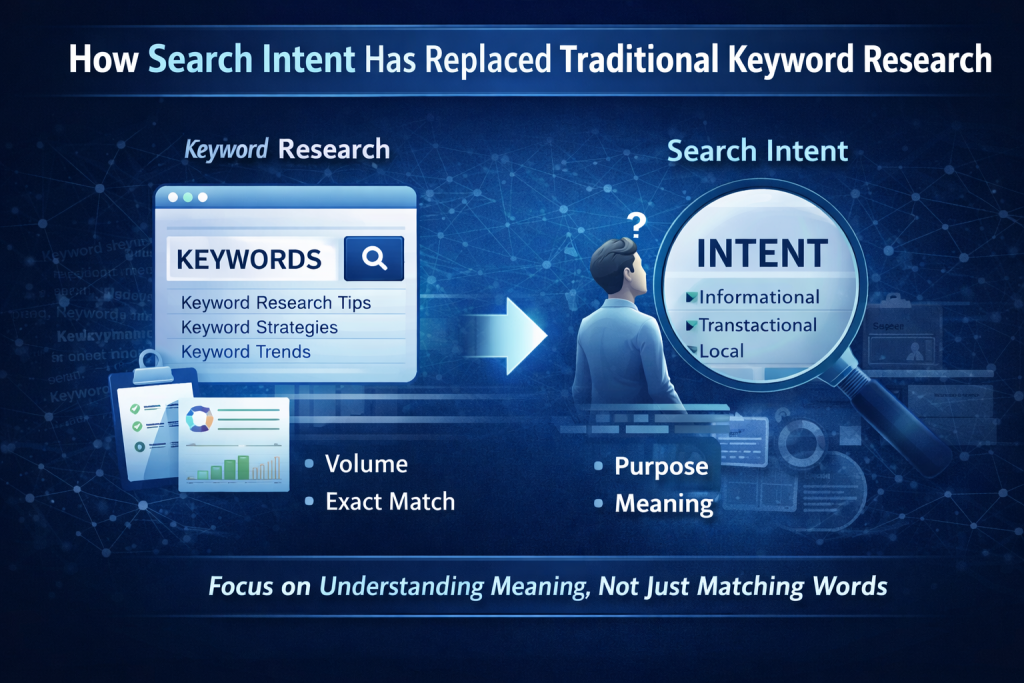
As mentioned in the introduction, in the past, keyword research focused significantly on numbers and data.
Marketers mainly focused on things like:
- Keyword difficulty
- Search volume
- Exact match phrases
Back then, the overall idea of keyword research was to find keywords that people were searching for and then include those words as many times as possible in a page. Over time, this led to websites stuffing keywords and being insanely repetitive with content. Now, even though this approach worked then (and even sometimes to this day), it often resulted in content being useless for readers.
What Keyword Research Looks Like Today
Again, as mentioned in the introduction, keyword research today focuses on being more intentional rather than just a word vomit of words. This can be summarized as “Search intent.”
To expand further on what search intent is, search intent is giving a reason behind a search. Instead of just asking what someone is typing, search engines now try to understand what people are actually trying to accomplish.
Here are some examples of the different types of search intent:
- Transactional: where someone is ready to take action
- Local: where someone is searching within a specific area
- Informational: where someone is looking to learn something
- Navigational: where someone is trying to find a specific site
All in all, this shift means that content needs to match the purpose of the search, not just the keyword itself.
Why Search Engines Made This Shift
Over time, search engines have become more technologically advanced due to improvements in artificial intelligence (AI). Instead of just simply matching keywords, systems like Google now analyze user behavior, relationships between words/topics, and how search intent works.
Now, according to Google Search Central, useful and helpful content that is MADE FOR PEOPLE rather than search engines is now prioritized in rankings. This tells us that content that clearly answers questions and provides VALUE is highly likely to perform very well. This of course, resulted in keyword based strategies alone no longer being enough.
How This Applies to Real Content Creation
Instead of building a page full of unnecessary wording and centered around one keyword, it is now more effective to build content around a topic.
For example, instead of just targeting a single phrase like “Michigan AI Optimization and Digital Marketing” or “SEO and GEO Best Practices in Michigan,” a much better approach would now be content created to explain what keyword research is, how to apply it in real situations, and how search intent works.
This makes the content more complete, more useful for readers, and makes it much easier for search engines to understand.
The KEY to Simple Strategy Moving Forward
INTENT should always be first when approaching keyword research. For example, instead of asking something like “What keyword should I target?” Ask something like “What is the user actually trying to find?” From there on, you can then do 3 things:
- Understand the user’s goal
- Identify the main topic
- Create content that directly answers that user’s need
Overall, this simple yet KEY strategy leads to stronger content and long term results.
Final Summary
To wrap up everything, keyword research (again) is no longer just about finding the right words and abusing that word within post(s). It is about understanding the meaning behind those words. As search engines continue to grow, content that focuses on intent, clarity, and overall usefulness will perform much better than just building content around keywords.
IN MODERN DIGITAL MARKETING, THE GOAL IS TO NOT JUST RANK, BUT TO PROVIDE VALUE!
Sources
Google Search Central: https://developers.google.com/search/docs/fundamentals/creating-helpful-content
Ahrefs Blog: https://ahrefs.com/blog/
Moz Beginner Guide to SEO: https://moz.com/beginners-guide-to-seo
Leave a Reply